The Look Out Post
Look Out Post No. 67
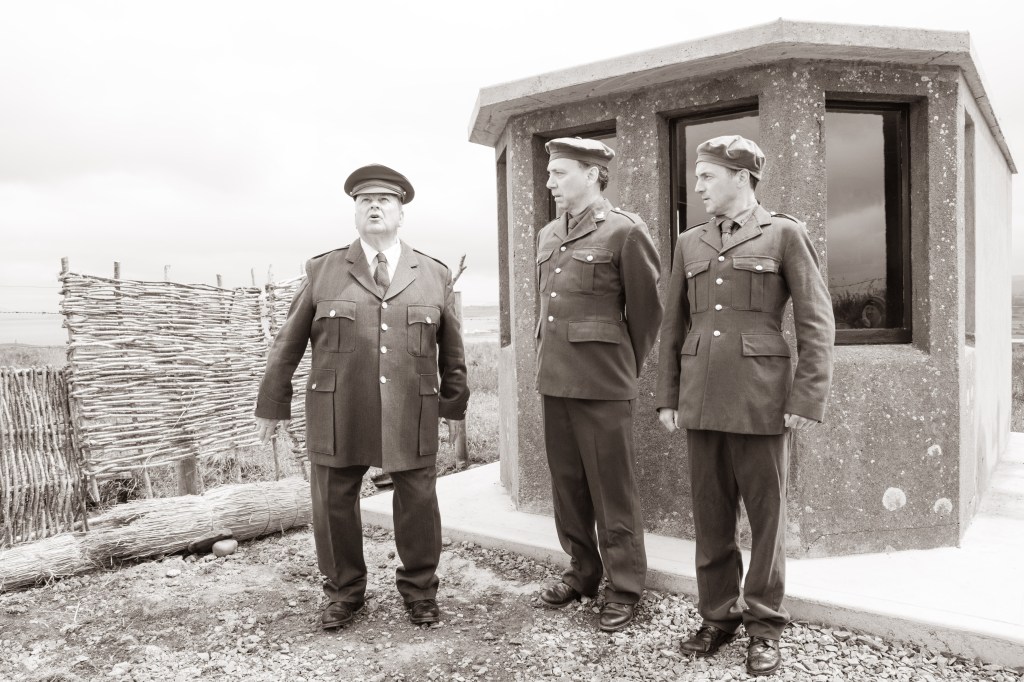
This small, square concrete hut played a significant role during World War II, or the Emergency as it was referred to in this country. Though Ireland remained neutral throughout the conflict of 1939-‘45, the war impacted on people in many different ways, particularly through the rationing of food, fuel and clothing.
But the areas around Aughris also witnessed the war at first hand, from the body of a German soldier being washed ashore through to the sighting of Allied aircraft. Despite the Irish Free State’s neutrality the country was on a defensive military footing for the duration of the war, and this led to the construction of 83 LOPs (Look Out Posts) which were constructed on headlands around the entire Irish coastline.
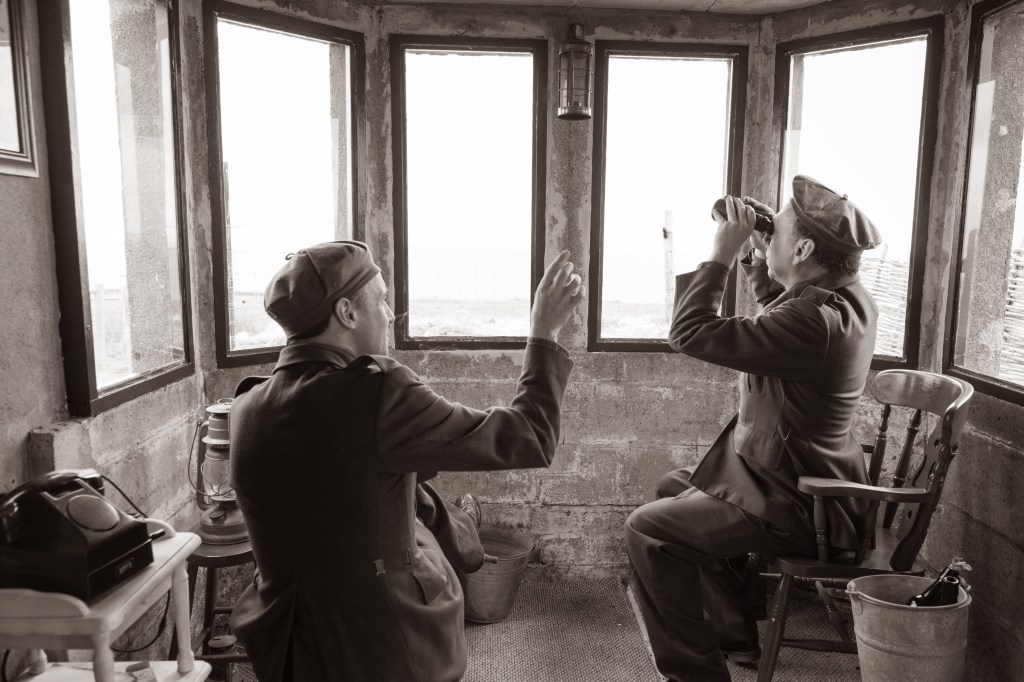
This LOP was manned by 7 men, mainly local volunteers, who watched over the seas to warn of attack or to report any military sightings to the authorities. Sligo LOPs had been built by the Winter of 1939-’40 and were made from pre-cast blocks which were delivered to the site. As temporary buildings, these structures were prone to let in wind and rain, and during stormy weather the walls and windows could leak badly. The tiny fireplace inside was said to have been of little use for burning turf, and in many instances the chimneys smoked.
With the possibility of a German invasion looming, telephones were installed at the LOP huts during the summer of 1940. Prior to this, coast watchers’ reports had to be conveyed by bicycle or by foot several miles away to the local Post Office.
By 1940 LOPs were to have a telescope, binoculars, drawings of various aircraft and ships, a logbook, signal flares, lamps, oilskin jackets and hats for each member and a bicycle.
By March 1944, over 20,000 aircraft were reported flying near or over Ireland. With the increasing numbers of aircraft there was a growing number of forced landings and crashes caused by crews losing their bearings or aircraft running low on fuel. It was then decided to construct large markers reading ‘EIRE’ adjacent to LOPs to indicate to aircrews that they were passing over Ireland.
Aughris was given the number 67 which was etched in a lime filled trench in the field adjacent to the LOP.
The log books of Aughris indicate the sighting of over a dozen American B17 Flying Fortress bombers and many Catalina Flying Boats on U-boat patrol. Other events recorded included the sighting of a mine which was seen drifting 6 miles west of Aughris in June 1941, and the washing ashore of the body of a German soldier near Templeboy who was buried in the old graveyard there.
Another example of how the war had a tangible impact on the community came about in 1940, following the sinking by German U-Boat of the Blue Star Line’s Arandora Star, sailing from Liverpool to St. John’s Newfoundland on 2 July of that year. Over 800 people lost their lives as it sailed off the coast of Bloody Foreland, Co. Donegal. Throughout the month that followed, over 200 bodies were washed up onto the west coast, including that of an unidentified Italian man, who was subsequently buried in nearby Easkey graveyard.
 The Chronicles of Aughris